
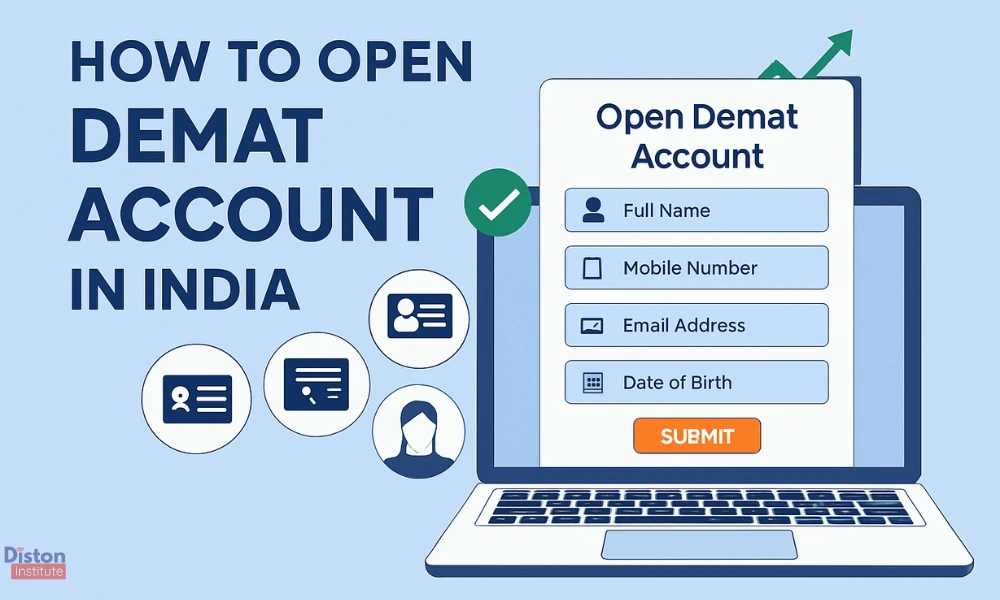

In today’s digital financial environment Demat accounts have made stock market investing more accessible. You’re in the right place if you’re new to the process or want to learn How to open Demat account in India. This guide will walk you through the entire process, the necessary paperwork, the advantages, and some practical advice to help you get started with confidence. If you’re looking to build a stronger foundation, you can also consider enrolling in a stock market course in Dehradun to enhance your understanding before investing.
Table of Contents
What is a Demat Account?
Holding shares and other securities in an electronic format is done with a Demat Account, which is short for “Dematerialised Account.” Shares were previously issued as physical certificates, which were challenging to handle and vulnerable to dangers like damage, loss, or theft. Through the conversion of physical shares into electronic form, a Demat account resolves these problems.
- Equity shares
- Bonds
- Mutual funds
- Exchange Traded Funds (ETFs)
- Government securities
- Debentures
In India, There are two depositories Who maintained Demat accounts are:
- NSDL (National Securities Depository Limited)
- CDSL (Central Depository Services Limited)
These depositories collaborate with Depository Participants (DPs), such as Groww, ICICI Direct, Upstox, Zerodha, and others, who provide retail investors with Demat account services.
Documents Required to Open a Demat Account
To open a Demat account, you need the following documents:
| Document | Purpose |
|---|---|
| PAN Card | Mandatory identity proof |
| Aadhaar Card | Address proof |
| Bank Statement | Proof of bank details |
| Passport-size photo | KYC process |
| Signature on paper | Verification |
| Income proof* | (Only for derivative/F&O trading) |
Only if you wish to trade in the Futures & Options (F&O) segments is proof of income (such as a pay stub or ITR) necessary.
How to open Demat A/c Step By Step
Most brokers allow you to open a Demat account online in less than ten minutes. Here is a detailed guide:
Step 1: Choose a Depository Participant (DP)
A broker or financial institution that is registered with the NSDL or CDSL and serves as a go-between for you and the depository is known as a DP.
Some popular DPs in India:
- Zerodha
- Upstox
- Groww
- Angel One
- ICICI Direct
- HDFC Securities
- Kotak Securities
- 5Paisa
You should choose a DP based on:
- Brokerage fees
- Annual Maintenance Charges (AMC)
- Trading platform features
- Customer support
- Mobile app rating
Step 2: Visit the Official Website or App
Visit the chosen broker’s official website or get their app on your phone. On the home screen, look for the “Open Demat Account” or “Sign up” options.
Step 3: Enter Your Basic Details
You will be asked to fill in:
- Full Name
- Mobile Number
- Email ID
- Date of Birth
- PAN Card Number
Verify your mobile and email via OTP.
Step 4: Upload KYC Documents
Upload clear photos or scanned copies of:
- PAN Card
- Aadhaar Card
- Bank statement or cancelled cheque
- Your signature on white paper
- Passport-sized photograph
Some apps allow you to take live pictures during the process.
Step 5: Complete eKYC and IPV
- The majority of platforms provide eKYC based on Aadhaar via DigiLocker or OTP authentication.
- A brief video call or a brief video recording in which you hold your PAN card and say your name could be used for IPV (In-Person Verification).
Step 6: Choose Account Type and Preferences
Select whether you want:
- Only a Demat Account
- Demat + Trading Account
Also, select:
- Investment segments (Equity, Mutual Funds, F&O)
- Account type (Individual, Minor, Joint)
Step 7: E-sign the Application
Use eSign or OTP-based authentication to digitally sign your application using your Aadhaar-linked mobile number.
Step 8: Account Activation
After verification, you’ll receive:
- Client ID / BO ID (your unique Demat number)
- Login credentials for the trading platform
This process usually takes 24–48 hours, but some brokers activate it within a few hours.
Benefits of Having a Demat Account
Opening a Demat account comes with several advantages:
Easy & Paperless Investing
Bonds, mutual funds, ETFs, and shares can all be purchased online and without paper records.
Safe & Secure
Unlike physical share certificates, there is no chance of theft, loss, or damage.
Real-Time Access
Instantly check your holdings and portfolio online or on your phone.
Seamless Transactions
Integrated trading platforms make it easy and quick to buy and sell shares.
Automatic Updates
Your Demat account receives direct credit for corporate benefits like stock splits, bonus shares, and dividends.
Charges Involved in a Demat Account
The following are the usual fees involved:
| Type of Charge | Range |
|---|---|
| Account Opening Fee | ₹0 – ₹500 (many offer free) |
| Annual Maintenance Fee | ₹0 – ₹500 per year |
| Brokerage Charges | Depends on broker (₹0–₹20/trade) |
| DP Charges (per transaction) | ₹10 – ₹25 |
Certain brokers, such as Groww or Zerodha, provide a flat ₹20 per order broking with zero AMC.
Pro Tips Before You Open a Demat Account
1. Compare Brokers:
To compare costs, platform reviews, and usability, use online comparison tools.
2. Watch Out for Hidden Charges:
Read the terms carefully because some brokers claim to offer “free Demat accounts” but have hidden costs.
3. Use Mobile App Reviews:
To evaluate platform performance, look at reviews and ratings in the app store.
4. Start Small:
Before making high-risk trades, start with modest equity or mutual fund investments.
5. Secure Your Account:
For extra security, always create strong passwords and turn on two-factor authentication (two-factor authentication).
Conclusion
The first step to investing in the Indian stock market and increasing your wealth is to open a Demat account. Anyone can begin investing in a matter of minutes thanks to the availability of quick online account opening services. Select a trustworthy broker, prepare your paperwork, and adhere to the previously mentioned procedures.
In the era of digital investing, having a Demat account is essential, regardless of your goals: investing for long-term wealth creation, trading for short-term gains, or just experimenting with the stock market.
FAQ’s About How to open Demat Account
1. Is a Demat account free to open?
Indeed, a lot of brokers, including Groww, Upstox, and Zerodha, provide free Demat account opening.
2. Can I open multiple Demat accounts?
It is possible to open more than one account with a single broker, but only one per broker.
3. Is PAN card mandatory?
In accordance with SEBI regulations, opening a Demat account does require a PAN card.
4. Do I need a trading account with my Demat account?
You will need both if you wish to purchase or sell shares. Your shares are kept in a Demat account, and you can trade them with a Trading account.
5. Can I open a Demat account without Aadhaar?
Aadhaar is needed for eKYC by the majority of online brokers. It is slower to open offline with other documents.