
Table of Contents
Introduction
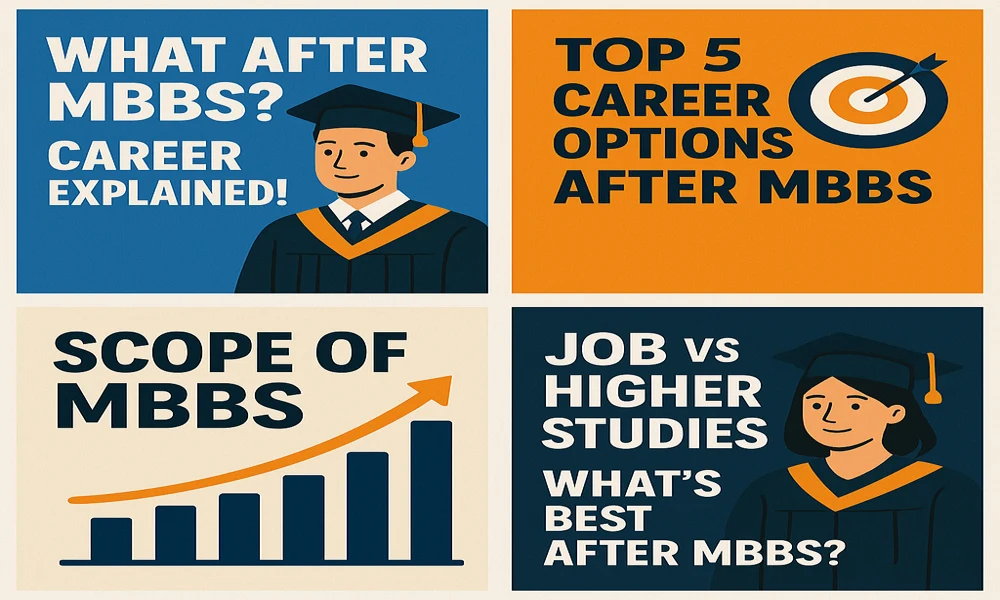
MBBS, or Bachelor of Medicine and Bachelor of Surgery, is the first step for anyone aspiring to become a doctor. It is one of the most respected and in-demand degrees in the field of healthcare. The scope of MBBS is not limited to clinical practice; it extends to medical research, public health, hospital management, and international healthcare roles. With increasing health awareness and expanding healthcare infrastructure, the scope of MBBS continues to grow each year. From government jobs to private hospitals and global opportunities, the scope of MBBS is wide and evolving. For students passionate about medicine, the scope of MBBS promises both professional success and meaningful impact on society.
Scope of MBBS in India and Abroad
The healthcare sector has seen exponential growth, especially post-COVID-19, resulting in a higher demand for trained medical professionals. The scope of MBBS has never been more promising.
In India
- India faces a shortage of qualified doctors, especially in rural and semi-urban areas.
- Government initiatives like Ayushman Bharat and Health for All aim to increase healthcare access, which further boosts the demand for MBBS graduates.
- There is also a rising demand for specialized doctors, making post-MBBS specialization programs highly valuable.
Abroad
- Countries like the UK, USA, Canada, and Australia are constantly in search of skilled doctors.
- With appropriate licensing exams (like USMLE, PLAB), MBBS graduates from India can pursue a thriving international career.
Key Skills You Will Learn in MBBS
- Clinical Diagnosis
- MBBS trains you to identify diseases through symptoms, physical examination, and investigations. You learn to assess patients critically and make informed decisions.
- Patient Communication
- One of the most essential skills is how to communicate effectively with patients—explaining conditions, treatments, and offering emotional support with empathy.
- Anatomical & Physiological Understanding
- A deep knowledge of human anatomy and physiology helps you understand how the body works, which is essential for identifying abnormalities.
- Medical Ethics and Professionalism
- You’re taught how to uphold patient confidentiality, make ethical decisions, and practice with integrity and responsibility.
- Emergency Handling
- From trauma cases to cardiac arrests, MBBS equips you to handle medical emergencies with a calm and methodical approach.
- Teamwork and Leadership
- Working in hospitals means collaborating with nurses, paramedics, and senior doctors. You learn both how to follow and how to lead.
- Surgical Assistance Skills
- Though not surgeons yet, MBBS students learn the basics of assisting in surgeries, stitching wounds, and handling surgical tools.
- Interpretation of Tests and Reports
- Understanding blood tests, X-rays, ECGs, and MRIs is part of your clinical toolkit as a future doctor.
- Time Management & Multitasking
- Managing a busy schedule between classes, practicals, night duties, and patient care teaches you how to prioritize and handle pressure.
- Research and Analytical Thinking
- MBBS also fosters critical thinking. You learn how to read medical journals, conduct basic research, and question existing practices.
Career Scope After MBBS – List of Opportunities
- General Physician
Treating everyday illnesses and managing patient care in hospitals or private clinics. - Medical Officer (Government Jobs)
Working in public health departments, armed forces, railways, or municipal bodies. - Postgraduate Specialization (MD/MS/DNB)
Pursuing higher studies in fields like Medicine, Surgery, Pediatrics, Radiology, etc. - Super-Specialization (DM/MCh)
Advanced medical degrees for high-demand specialties like Cardiology, Neurology, Oncology. - Junior Resident / House Surgeon
Training roles in hospitals to gain real-time clinical experience. - Medical Researcher
Working in research institutions or pharmaceutical companies on drug development and disease study. - Healthcare Administrator
Managing hospitals, clinics, or health organizations with additional management qualifications. - Teaching & Academics
Becoming a lecturer or professor in a medical college after postgraduate education.
Job Roles After MBBS with Salary (India-Based Estimates)
| Job Role | Description | Average Monthly Salary |
|---|---|---|
| General Physician | Diagnoses and treats common health issues; private clinics or hospitals. | ₹50,000 – ₹1,00,000 |
| Medical Officer (Govt Jobs) | Works in government hospitals, railways, or public health departments. | ₹60,000 – ₹1,20,000 + benefits |
| Junior Resident Doctor | Assists in hospitals under senior doctors; common post-internship role. | ₹50,000 – ₹90,000 |
| House Surgeon | Works in surgery departments gaining practical experience. | ₹45,000 – ₹80,000 |
| Emergency Medical Officer | Manages critical patients in ER setups in hospitals. | ₹60,000 – ₹1,00,000 |
| Research Associate | Works in medical or pharmaceutical research labs and institutions. | ₹30,000 – ₹70,000 |
| Public Health Consultant | Works with NGOs, WHO, or govt. health missions on public health projects. | ₹50,000 – ₹1,00,000 |
| Telemedicine Consultant | Provides online consultations for digital health platforms. | ₹40,000 – ₹90,000 |
| Medical Content Writer | Writes health articles, medical guides, or works with ed-tech firms. | ₹25,000 – ₹60,000 (freelance too) |
| Clinical Research Coordinator | Manages clinical trials in pharma or hospitals. | ₹40,000 – ₹80,000 |
| Hospital Administrator (with MBA) | Leads operations and patient care services in healthcare setups. | ₹70,000 – ₹1,50,000 |
| Health Insurance Medical Advisor | Works with insurance firms to assess health claims. | ₹50,000 – ₹1,00,000 |
| Medical Tutor/Teaching Assistant | Assists in medical education in colleges or coaching institutes. | ₹30,000 – ₹70,000 |
Top Recruiters for MBBS Graduates in India
| Recruiter / Organization | Type | Opportunities Offered |
|---|---|---|
| AIIMS (All India Institute of Medical Sciences) | Government Institute | Junior resident, research fellow, medical officer, academic roles |
| Apollo Hospitals | Private Hospital Chain | General physicians, emergency doctors, duty medical officers |
| Fortis Healthcare | Private Hospital Chain | Department-wise doctors, ICU support, surgery assistance |
| Max Healthcare | Multi-Specialty Hospital | Resident doctors, OPD consultants, emergency care roles |
| Indian Army Medical Corps | Government / Defense | Army doctors, hospital-based and field medical officer roles |
| Tata Memorial Centre | Govt-Aided Cancer Centre | Oncology trainees, junior doctors, research positions |
| Manipal Hospitals | Private Healthcare Network | Clinical assistants, general physicians, specialty support |
| Wockhardt Hospitals | Private Hospital Chain | Internal medicine, ICU, OPD and in-patient medical roles |
| Medanta – The Medicity | Super-Specialty Hospital | Junior doctors, department trainees, surgical support roles |
| Indian Railways Health Services | Government Sector | Medical officers, railway hospital doctors, public health roles |
| ESIC Hospitals | Central Government Hospitals | Staff doctors, duty medical officers, OPD consultants |
| Practo, DocsApp, Tata Health | Health Tech Companies | Telemedicine consultants, online patient care advisors |
| WHO / UNICEF / NGO Sector | International / Public Health | Field doctors, health advisors, research and outreach workers |
| Private Diagnostic Labs & Clinics | Private Sector | General practitioners, lab consultants, diagnostic specialists |
Who Should Pursue MBBS
Ideal for:
- Students with a deep interest in biology and human anatomy
- Those who are passionate about helping and healing others
- Individuals who can handle pressure and work long hours
- People with strong communication and decision-making skills
- Students who are emotionally resilient and mentally strong
- Those willing to commit to continuous learning throughout life
- Individuals aiming for a respected and meaningful profession
- Students who enjoy problem-solving and critical thinking in real-life scenarios
MBBS Course Structure and Subjects Covered
The MBBS program in India typically spans 5.5 years, which includes 4.5 years of academic study and 1 year of compulsory internship. The curriculum is divided into phases, and each phase covers a mix of theory, practicals, and clinical training.
1st Year (Pre-Clinical Phase)
Duration: 12 months
Focus: Basic medical sciences – foundation of human anatomy and function
Subjects Covered:
- Anatomy
- Physiology
- Biochemistry
2nd Year (Para-Clinical Phase)
Duration: 12 months
Focus: Understanding diseases, pathology, and patient interaction begins
Subjects Covered:
- Pathology
- Pharmacology
- Microbiology
- Forensic Medicine & Toxicology
- Introduction to Community Medicine and Clinical Postings
3rd Year – Part 1 (Short Clinical Phase)
Duration: 12 months
Focus: Beginning of in-depth clinical exposure
Subjects Covered:
- Community Medicine
- Otorhinolaryngology (ENT)
- Ophthalmology
3rd Year – Part 2 / Final Year (Advanced Clinical Phase)
Duration: 12 months
Focus: Core clinical subjects and hospital-based learning
Subjects Covered:
- General Medicine
- General Surgery
- Pediatrics
- Obstetrics and Gynaecology
- Orthopaedics
- Dermatology, Psychiatry & Radiology (brief modules)
Top Institutes in India Offering MBBS
| Institute Name | Location | Type | Entrance Exam |
|---|---|---|---|
| AIIMS (All India Institute of Medical Sciences) | New Delhi & other cities | Government | NEET-UG |
| CMC (Christian Medical College) | Vellore, Tamil Nadu | Private | NEET-UG |
| Maulana Azad Medical College (MAMC) | New Delhi | Government | NEET-UG |
| AFMC (Armed Forces Medical College) | Pune, Maharashtra | Government/Defence | NEET-UG + Interview |
| JIPMER (Now under NEET-UG) | Puducherry | Government | NEET-UG |
| KMC (Kasturba Medical College) | Manipal, Karnataka | Private | NEET-UG |
| BHU Institute of Medical Sciences | Varanasi, UP | Government | NEET-UG |
| Lady Hardinge Medical College | New Delhi | Government | NEET-UG |
MBBS Eligibility Criteria
Getting admission into the MBBS program in India requires fulfilling a few essential conditions. These are set by regulatory bodies to ensure that only qualified and deserving candidates pursue the medical field. Meeting academic qualifications, clearing entrance exams, and falling within the age limit are key factors for eligibility.
Here’s a simple table with the main eligibility details:
| Criteria | Details |
|---|---|
| Educational Qualification | 10+2 with Physics, Chemistry, Biology, and English as core subjects |
| Minimum Marks Required | General: 50%, OBC/SC/ST: 40% (in PCB subjects) |
| Entrance Exam | NEET-UG is mandatory across all government and private medical colleges |
| Minimum Age | 17 years as on 31st December of the year of admission |
| Maximum Age | No upper age limit (as per latest NEET guidelines) |
| Nationality | Indian citizens, NRIs, OCIs, PIOs, and Foreign Nationals can apply |
Make sure all criteria are met before applying, as even a small mistake can lead to disqualification during admission or counselling.
FAQs About Scope of MBBS
What is the career scope after MBBS?
MBBS offers a wide range of career options including clinical practice, government jobs, medical research, teaching, hospital management, and specialization through postgraduate studies.
What is the future of MBBS in India?
With rising healthcare needs, government initiatives, and digital medical platforms, the future scope of MBBS is expanding rapidly across clinical and non-clinical domains.
Can I start a clinic after MBBS?
Yes, after completing your MBBS and obtaining the necessary medical license, you are legally allowed to open and run a private clinic as a general practitioner.
How much can a doctor earn after MBBS in India?
A fresh MBBS graduate typically earns between ₹40,000 to ₹1,00,000 per month, which increases significantly with experience, location, and qualifications.
What are the government job options after MBBS?
MBBS graduates can work in state and central government hospitals, ESIC, Railway Health Services, or join as Medical Officers in public health departments. They can also apply for UPSC CMS or serve in the Armed Forces Medical Corps.
Can I switch from BDS to MBBS?
No, direct switch isn’t allowed. You would have to retake the NEET in order to be admitted in MBBS
Conclusion
MBBS is more than just a degree—it’s a lifelong responsibility toward human health and well-being. It prepares students not only with medical knowledge but also with values like compassion, patience, and resilience. With vast career options in clinical practice, research, administration, and global healthcare, the field offers both purpose and professional growth. For those truly passionate about healing and serving society, MBBS is a meaningful and rewarding journey.
Explore More Courses: